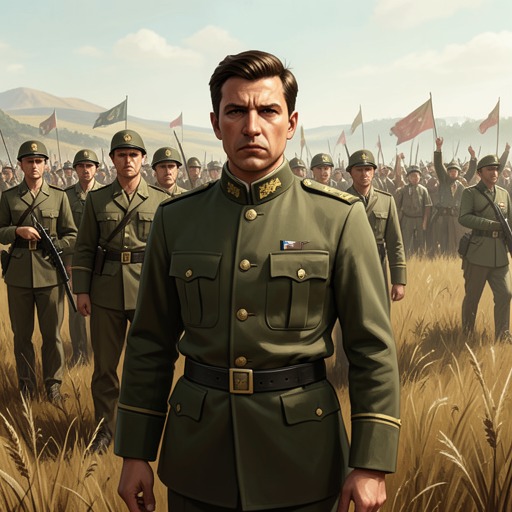
Revolutionary Resistance and Armed Struggle
My Tender MatadorRevolutionary resistance and armed struggle are presented as both a challenge to Augusto Pinochet’s authority and a force that draws ordinary lives into political danger. The novel connects the Front’s armed action to the Dictator’s escalating threats, the Queen of the Corner’s unwittingly consequential assistance, and the searches and fear that follow. Its account does not isolate resistance from daily life: radio reports, neighborhood gossip, a house used for meetings, and the Queen’s later flight all show how political conflict enters domestic spaces and personal relationships.
Political Climate and the Language of Resistance
The neighborhood’s political conversation takes place amid unemployment and small acts of mutual dependence, with the grocery store serving as a gathering point for opinions about demonstrations, opposition statements, and the Dictator’s threats. Residents repeat the hopeful forecast that 1986 will be the year he falls and call for people to take to the streets. Resistance thus appears first as public talk and expectation, rather than as an action detached from the neighborhood that will bear the consequences.
The Queen becomes part of this social world, though she does not initially share everyone’s political commitments. Her neighbors notice packages and boxes going into and out of her home and speculate about them, while she dismisses their scrutiny as gossip. Her domestic work continues alongside the crisis: she listens to Radio Cooperativa while soaking an embroidered tablecloth. When the station reports that students have been injured and arrested after university unrest, she worries that Carlos may be among those detained and considers asking Doña Catita whether her husband, a general, could help. The broadcast turns political news into an immediate, personal fear.
The Dictator’s Threats and the Coming Attack
On September 11, Augusto Pinochet delays his return to Santiago from the Cajón del Maipo, where unrest, student protests, bombs, and blackouts are expected. He considers imposing a curfew and putting the army in charge, and threatens severe measures against Communists who challenge him. His confidence is expressed in a contemptuous order to his bodyguards concerning a limping dog they mock; the episode makes the threat of state violence part of an ordinary roadside moment.
The motorcade’s return becomes the point at which resistance takes armed form. As the cars travel through the mountains, the lead vehicle brakes abruptly at a trailer blocking the road. The convoy swerves, and gunfire strikes the vehicles. The chauffeur tells the Dictator to get down; Pinochet, pressed to the floor, stammers in fear, while the guards fail to respond effectively. The scene reverses his earlier confidence: the man who had threatened to use force against his opponents is suddenly exposed to an attack he cannot command or control.
The Queen experiences the attack through a different, mediated scene. At a movie house, she can no longer follow the film clearly and imagines Carlos among the attackers, climbing over rocks and firing as he evades danger. Her warning to him is spoken into the movie’s action, as if the screen had become a passage into the real event. The narrative leaves open whether she truly sees Carlos or imagines him there; what it makes unmistakable is how her love and fear draw her into the event even at a distance.
Flight, Survival, and the State Response
At twenty past seven, the slopes of the Cajón del Maipo are lit by the explosion, and the vehicles are left burning. The Dictator’s chauffeur reverses through the damaged cars, turns the Mercedes around, and escapes with him. The survival of the Dictator does not undo the attack’s immediate effect: the motorcade is in disarray, and the regime’s leader has experienced the vulnerability he had dismissed when threatening his opponents.
In the aftermath, Lucy recounts the attack as a family crisis and an indictment of the security detail. At the house, the High Command arrives by car and helicopter while the Dictator, freshly bathed, drinks tea with a tranquilizer prescribed by his doctors. Lucy says that Gonzalo had warned her against traveling, and that she canceled a planned shopping trip to Miami. She then mocks the cost and failure of the security arrangements, noting that seven of their men died while none of the attackers was killed or wounded. Her bitter joke that the government might have been better off hiring the Front turns the attack into a measure of the state’s failed protection as well as its military humiliation.
That night, the military response reaches into Santiago’s poorer neighborhoods. Soldiers occupy the city, close its roads, and conduct searches of cars, houses, and entire neighborhoods. Residents can be made to stand through the night in football fields; people are beaten and taken away in trucks on slight pretexts. The Queen stays awake with a kettle ready in case Carlos or his friends arrive, and keeps the radio low to follow the news. The contrast is stark: the attack is a direct action against the regime, while its aftermath exposes a much wider population to the regime’s force.
The Queen’s Exposure and the Meaning of Resistance
Before dawn, the Queen tries to erase signs that might connect her to the events. She burns papers bearing telephone numbers and addresses, sweeps away footprints, and cleans windows and surfaces before packing her most valued possessions into two bags. These acts are practical responses to the threat of a search, but they also mark a change in her circumstances: the home that had been part of her neighborhood life is no longer safe. From the roof, she looks toward the gray horizon and thinks of leaving, with the hope of seeing Carlos once more still present in her thoughts.
Later, Carlos tells her that the Front is protecting her and offers money for lodging and expenses for at least a few months, until she can return to Santiago. She challenges the explanation, asking whether the protection is really intended to protect the Front itself, since its members never trusted her. Carlos acknowledges that her suspicion may be true, while also expressing gratitude for her cooperation. The exchange makes the relationship’s political and personal tensions explicit: she has been involved in the Front’s operations, but involvement has not meant equality or full trust.
The novel therefore presents revolutionary resistance as a force with more than one consequence. The motorcade attack punctures the Dictator’s performance of invulnerability, but it is followed by coercive searches that endanger people far beyond the armed participants. For the Queen, political involvement is neither a clean conversion into a militant nor a distant spectatorship. It becomes a material risk to her home, an estrangement from Santiago, and a painful entanglement with Carlos and the Front. By bringing the attack into a cinema, a household, a radio broadcast, and a conversation about money and trust, the narrative makes armed struggle inseparable from the vulnerable lives caught in its wake.